
Elon Musk’s Tweet: A Bold Invitation to Software Engineers for the ‘Everything App’
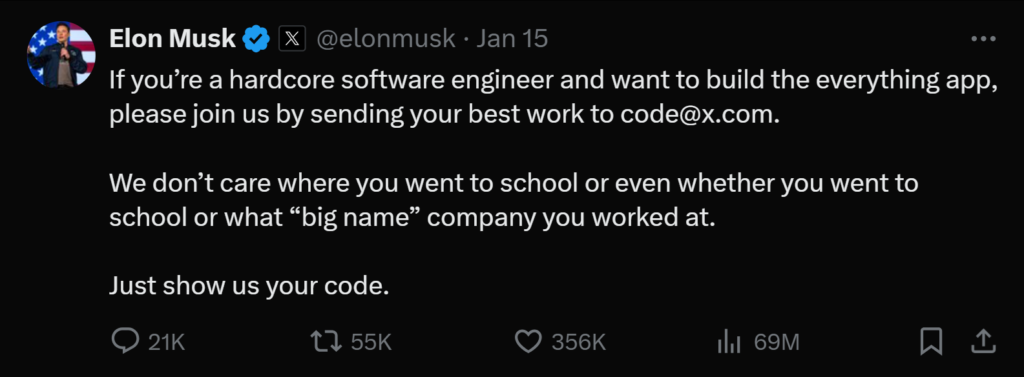
On January 15, 2025, Elon Musk made waves on Twitter with a tweet that garnered significant attention from the tech community. The tweet read:
“If you’re a hardcore software engineer and want to build the everything app, please join us by sending your best work to code@x.com. We don’t care where you went to school or even whether you went to school or what “big name” company you worked at. Just show us your code.”
This tweet is not just another call for job applications or an attempt to attract top talent. It encapsulates Musk’s vision for the future of digital ecosystems, his belief in merit-based talent acquisition, and a profound challenge to the traditional hiring paradigms that have long governed Silicon Valley and the tech industry at large.
Let’s break down this tweet, analyze its implications, and explore what it could mean for both the software engineering community and the future of technological development.
The “Everything App” Concept: A Visionary Idea
Musk’s reference to the “everything app” is a glimpse into a larger vision that many have speculated about for years. An “everything app,” or a super-app, is a single platform that integrates a multitude of services and functionalities, allowing users to handle various aspects of their digital lives—social networking, payments, e-commerce, navigation, entertainment, and even healthcare—all in one place.
One of the most notable examples of an everything app is WeChat in China. It has revolutionized the way people interact with technology by combining multiple features into a single user interface. Users can message, pay bills, book taxis, order food, and make appointments—among many other tasks—within the app. However, in the West, there has been no single platform that has reached this level of ubiquity and versatility.
Elon Musk’s ambitions for the “everything app” could take the form of a platform that integrates elements of social media (Twitter/X), e-commerce, banking, content consumption, and more. Musk has already signaled an interest in merging these functions through his acquisition of Twitter (now X) and his other ventures, including Tesla, SpaceX, and the Boring Company.
But what would an “everything app” built by Musk look like? Would it be an open ecosystem, allowing third-party integrations, or would it become a closed platform like Apple’s App Store or Google Play? Musk’s tweet doesn’t provide answers to these questions, but it opens the door for engineers to come together and be part of an innovative journey.
“Hardcore Software Engineers” – The Call to Action
By using the phrase “hardcore software engineer,” Musk is setting a high bar for the kind of talent he is looking to attract. The term “hardcore” suggests not just proficiency in software engineering, but a passion for coding, a deep understanding of the technical nuances, and the ability to push the boundaries of what’s possible. Musk is inviting individuals who are committed to tackling the monumental challenge of creating something that could redefine digital life.
The term also suggests that Musk values skill and determination over traditional credentials like educational background or work experience. In traditional tech hiring practices, much emphasis is placed on a candidate’s academic pedigree (i.e., Ivy League degrees) or the name recognition of previous employers (e.g., Google, Facebook, Microsoft). Musk’s tweet subverts this status quo by stating that such factors are irrelevant to him. Instead, he focuses solely on one’s ability to produce quality code.
This brings a refreshing perspective to an industry that often gets bogged down in the debate over whether candidates should have formal degrees in computer science or whether they should come from established tech giants. Musk’s tweet highlights the idea that talent can emerge from unconventional paths. A developer with a non-traditional background but excellent problem-solving skills and coding proficiency could potentially have a seat at the table in this revolutionary project.
The Importance of Code Over Credentials
Musk’s emphasis on showing “your best work” speaks volumes about his priorities in building his team. Traditional hiring processes often involve a lengthy interview process, tests, and assessments to determine if a candidate is qualified. However, Musk is asking candidates to directly showcase what they have built. This aligns with his philosophy of valuing output over traditional indicators of success. It’s a signal that Musk believes that the best measure of a software engineer’s abilities is the code they write and the real-world impact of their work.
This approach could attract a wide range of developers from all walks of life—self-taught programmers, developers who have worked in smaller companies, and those who may have worked on open-source projects but have no formal degree or affiliation with a major tech corporation. It democratizes the hiring process and shifts the focus from an applicant’s pedigree to their practical abilities and passion for building innovative products.
The invitation to submit “your best work” suggests that Musk is looking for a portfolio approach rather than a resume. In today’s tech world, many software engineers already showcase their skills through personal projects, GitHub repositories, and contributions to open-source communities. Musk is tapping into this trend by giving engineers a chance to demonstrate their abilities through the actual work they have done rather than relying on the sometimes misleading traditional metrics of experience or education.
A New Era of Hiring in Tech?
Musk’s tweet could mark the beginning of a significant shift in how tech companies approach hiring. If Musk’s “everything app” is realized, it could serve as a proof of concept for other companies that the traditional methods of hiring—placing emphasis on resumes and degrees—are outdated.
By inviting developers to send their best code instead of their resumes, Musk is positioning himself as an advocate for the meritocratic system in hiring. This approach has the potential to challenge the exclusivity of Silicon Valley hiring practices, which often favor candidates from prestigious universities or established companies. Musk’s tweet suggests a future where software engineering talent is not defined by where you went to school or which company you worked for but by your ability to solve problems and create innovative solutions.
This democratization of talent acquisition could lead to more diverse teams, as people from various backgrounds (including those without formal education or previous top-tier experience) are given an equal opportunity to showcase their abilities. It could also provide opportunities for those who may not fit into traditional hiring molds but have exceptional coding skills.
Challenges in Building the ‘Everything App’
Building an “everything app” is no small feat. It requires integrating a wide range of services and technologies, and creating a seamless, secure, and intuitive experience for users. Elon Musk’s call to software engineers is an invitation to work on a project that could change the fabric of how people interact with technology.
For a developer, being part of a project like this would offer unique challenges. The scale of the project would require engineers to work on large-scale systems, with considerations around security, performance, and user experience at the forefront. Additionally, building a platform that integrates so many different services would require expertise across a wide range of disciplines—frontend development, backend systems, cloud infrastructure, artificial intelligence, and machine learning, among others.
Musk’s vision is also deeply intertwined with his other ventures, such as Tesla, SpaceX, and Neuralink. An “everything app” could have applications in all these industries, from autonomous driving and space exploration to brain-machine interfaces. The integration of these industries into a singular app would require engineers to think beyond the conventional and push the boundaries of what technology can do.
Implications for the Future of Software Engineering
Elon Musk’s tweet signifies a future where software engineering is driven more by passion, creativity, and practical skill than by institutional credentials. It reflects a changing landscape in the tech industry, where engineers can have a meaningful impact regardless of their background, location, or educational history.
If Musk succeeds in building the “everything app” and if it becomes as successful as his other ventures, it could set a new standard for software development. The approach of hiring based solely on the quality of work and innovation could ripple across the industry, leading to a wave of tech companies that prioritize real-world solutions over formal qualifications.
Moreover, the success of this app could redefine the very way we interact with technology. It could lead to more streamlined, accessible, and user-centric digital ecosystems, where everything a person needs is available in one integrated platform. If Elon Musk and his team of software engineers can bring this vision to life, it could become the digital frontier for the future, where the boundaries between apps and services blur, making way for a truly connected world.
Conclusion
Elon Musk’s tweet on January 15, 2025, is more than just a recruitment pitch. It is an invitation to be part of something transformative—an effort to build a platform that could revolutionize the way we use technology. By focusing on “hardcore software engineers” and valuing code over credentials, Musk is reshaping how software development teams are formed, and in doing so, challenging the status quo of hiring in the tech industry. If successful, this project could not only create the next generation of digital platforms but also usher in a new era of meritocratic talent acquisition in tech.
